Lesson 1 Overview and Objectives

This lesson provides an overview of the Declaration Process and Public Assistance Program Eligibility.

Upon completion of this lesson, participants will be able to:

  • Identify administrative requirements of the course
  • State the goals and objectives of the course
  • Describe the Declaration Process and the authorization of Public Assistance
  • Identify the authorities, regulations, statutes, and program guidance that control the Public Assistance process in determining eligibility
Declaration Process and Authorization of Public Assistance

During certain disasters and emergencies, the President of the United States is given authority to provide Federal assistance through the Robert T. Stafford Disaster Relief and Emergency Assistance Act, as Amended (Stafford Act), Title 42 of the United States Code (U.S.C.) § 5121 et seq.

The Stafford Act authorizes the President to provide Federal assistance when the magnitude of an incident or threatened incident exceeds the affected State, Territorial, Tribal, and Local government capabilities to respond or recover.

The President provides authorization for Federal assistance through two types of declarations:

  • Emergency declarations
  • Major disaster declarations
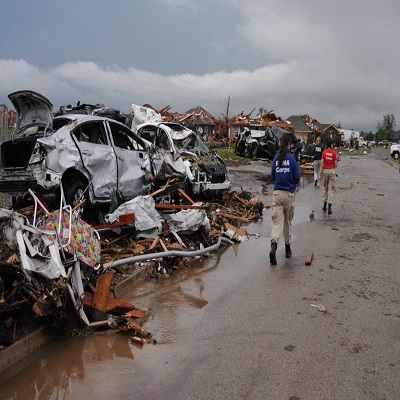
FEMA Staff and FEMA Corps members walking through a disaster site.
Presidential Declarations

When a State, Territorial, or Tribal government determines that an incident may exceed SLTT capabilities to respond, it requests a joint Preliminary Damage Assessment (PDA) with FEMA. Federal, SLTT government, and certain PNP organization officials work together to estimate and document the impact and magnitude of the incident.

The Governor or Tribal Chief Executive may request a declaration from the President through FEMA. A Tribal government may elect to be a Recipient or a Subrecipient under a State or Territorial declaration or request its own declaration as a Recipient. The Governor, and/or the Tribal Chief Executive if the Tribal Government wishes to be its own Recipient, must submit the request no later than 30 days after the incident occurs. FEMA may extend the deadline if the Governor or Tribal Chief Executive submits a written time extension request within 30 days of the incident stipulating the reason for the delay. When a severe or catastrophic incident occurs, the Governor or Tribal Chief Executive may submit a declaration request prior to completion of the Preliminary Damage Assessment (PDA). This is referred to as an expedited declaration request. In such circumstances, assistance is generally limited to that which would address immediate needs based on rapid assessments until the PDA is completed.

For FEMA to provide assistance, the President must declare that an emergency or major disaster exists.

The declaration establishes:

  • Type of incident
  • Incident period
  • Designated areas
  • Types of assistance
  • Federal cost share
  • Federal Coordinating Officer (FCO)


The following slides take a closer look at each of the components of a presidential disaster declaration.

Presidential Declaration: Federal Cost Share
Upon a Presidential Declaration, the Public Assistance Program is subjected to a Federal cost share.

The Federal share has a minimum of 75 percent of eligible costs:

  • If Federal obligations, excluding administrative costs, meet or exceed a qualifying threshold, FEMA may recommend an increase up to 90 percent
  • The Federal cost share for Emergency Work may be increased in limited circumstances if warranted
Presidential Declaration: Type of Incident

The President provides authorization for Federal assistance through two types of declarations. The declarations designate the type of incident.

Emergency Declarations:

  • An incident that the President determines warrants supplemental emergency assistance to save lives and protect property, public health, and safety, or to lessen or avert the threat of a catastrophe

Major Disaster Declarations:

  • An incident is any natural catastrophe (including any hurricane, tornado, storm, high water, wind driven water, tidal wave, tsunami, earthquake, volcanic eruption, landslide, mudslide, snowstorm, or drought), or regardless of cause, fire, flood, or explosion
  • Major Disaster Declarations may include a combination of incident types, such as storms and landslides
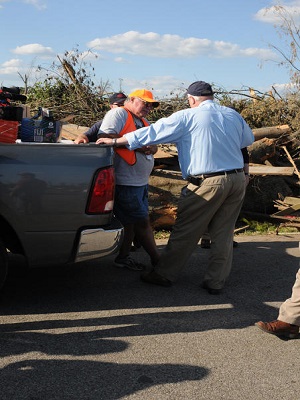
FEMA Administrator at Alabama Disaster Site.
Presidential Declaration: Types of Assistance

The declaration also designates the types of authorized Federal assistance. The President may authorize assistance to:

  • Individuals and households through its Individual Assistance program
  • State, Territorial, Tribal, and Local governments, and certain types of private nonprofit organizations through its Public Assistance program

The type of assistance available may vary among designated areas and FEMA may add additional types of assistance after the declaration. However, for FEMA to consider adding additional types of assistance, the Governor or Tribal Chief Executive must request the assistance within 30 days of the declaration date or the end of the incident period, whichever is later. FEMA may extend the deadline if the Governor or Tribal Chief Executive submits a written time extension request within the 30-day deadline with justification of the inability to meet the deadline.

Required Forms and FEMA-State/Territory/Tribe Agreement (1 of 2)

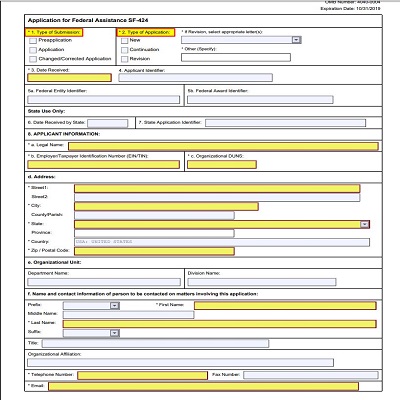
Before FEMA can provide any assistance through the Public Assistance Program, the declared State, Territorial, and/or Tribal Government must submit form SF 424, which is an Application for Federal Assistance, and form SF 424 - D, which includes assurances.

FEMA provides Public Assistance funds via the U.S. Department of Health and Human Services Payment Management System.

  • If the President issues a declaration for a Tribal Government for the first time, the Tribal Government must also submit form SF-1199A (a Payment Management System Access Form) and a Direct Deposit Form to obtain a FEMA-specific Payment Management System account before FEMA can provide funding.
SF 424 form
Required Forms and FEMA-State/Territory/Tribe Agreement (2 of 2)

Additionally, after every declaration, the applicable State, Territorial, or Tribal Government must enter into an agreement with FEMA regarding the understanding, commitments, and conditions under which FEMA will provide assistance (FEMA-State/Territory/Tribe Agreement).

FEMA and the Governor or Tribal Chief Executive must sign this agreement before FEMA provides assistance. If necessary, because of exigent circumstances, FEMA may authorize essential emergency services or housing assistance under the Individuals and Households Program while the agreement is in process for signature.

Presidential Declaration: Incident Period

The presidential declaration also designates the incident period.

The incident period is:

  • The span of time during which the federally declared incident occurs. This period varies in length, depending on the type of incident.
Presidential Declaration: Designated Areas

The declaration likewise designates which areas (e.g., county, parish, city, Tribal Government) are eligible to receive Federal assistance.

FEMA may add additional areas after the initial designation. However, for FEMA to consider adding an additional area, the Governor or Governor's Authorized Representative or, for Tribal declarations, the Tribal Chief Executive or Tribal Authorized Representative must request the addition within 30 days of the declaration date or the end of the incident period, whichever is later.

FEMA may extend the deadline if the Governor, Governor's Authorized Representative, Tribal Chief Executive, or Tribal Authorized Representative submits a written time extension request within the 30-day deadline with justification of the inability to meet the deadline.

Presidential Declaration: Federal Coordinating Officer

The declaration also identifies the Federal Coordinating Officer. The Federal Coordinating Officer works in partnership with the State Coordinating Officer and Governor's Authorized Representative (or for Tribal declarations, the Tribal Coordinating Officer and Tribal Authorized Representative) to coordinate Federal resources and disaster assistance programs.

FEMA and the State, Territorial, or Tribal Government may initially operate at Emergency Operations Centers and, when warranted, subsequently establish a Joint Field Office for Federal, State, Territorial, and Tribal government coordination and administrative activities.

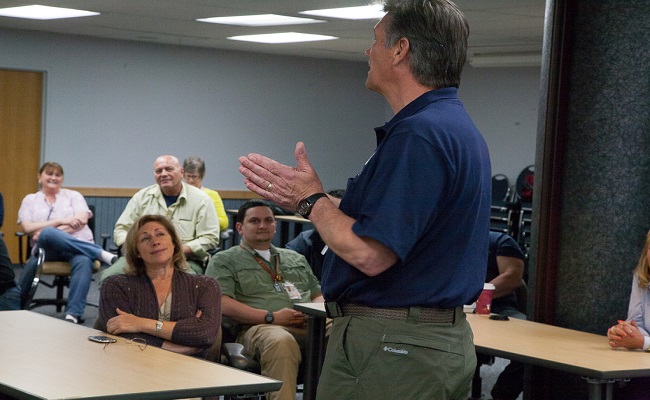
Federal Coordinating Officer briefing
Public Assistance Program Authorities

FEMA provides this assistance based on authority in statutes, Executive Orders, regulations, and policies. If an entity does not comply with all applicable statutes, Executive Orders, regulations, and policies, FEMA may take one of several actions including disallowing all or part of the cost of the project not in compliance.

The mission of FEMA's Public Assistance Program is to provide assistance to State, Territorial, Tribal, and Local governments, and certain types of private nonprofit organizations so that communities can quickly respond to and recover from major disasters or emergencies declared by the President.

Through the Public Assistance Program, FEMA provides supplemental Federal disaster grant assistance for debris removal, emergency protective measures, and the restoration of disaster-damaged, publicly owned facilities and the facilities of certain private nonprofit organizations. The Public Assistance Program also encourages protection of these damaged facilities from future events by providing assistance for hazard mitigation measures.

Public Assistance Program Statutes

Statutes are Federal laws passed by the U.S. Congress and signed by the President. All Public Assistance Program assistance must comply with all applicable statutes. The statute that authorizes FEMA to provide assistance via the Public Assistance Program is the Robert T. Stafford Act. The following sections of the Stafford Act specifically authorize the assistance FEMA provides under the Public Assistance Program:

  • Title I - Findings, Declarations and Definitions
  • Title III - Major Disaster and Emergency Assistance Administration
    • Sec. 311. Insurance
    • Sec. 312. Duplication of Benefits
    • Sec. 324. Management Costs
  • Title IV - Major Disaster Assistance Programs (applies to Major Disaster Declarations)
    • Sec. 403. Essential Assistance
    • Sec. 406. Repair, Restoration, and Replacement of Damaged Facilities
    • Sec. 407. Debris Removal
    • Sec. 428. Public Assistance Program Alternative Procedures
      • For more information on Alternative Procedures, please refer to IS-1005 Public Assistance Program Alternative Procedures Independent Study course and visit www.fema.gov.  
  • Title V - Emergency Assistance Programs (applies to Emergency Declarations)
    • Sec. 502. Federal Emergency Assistance
  • Title VII - Emergency Preparedness
    • Sec. 705. Disaster Grant Closeout Procedures
Public Assistance Program Regulations

Regulations are Federal rules with the force and effect of law that implement a statute based on a Federal agency's interpretation of that statute. FEMA and any entity receiving assistance must comply with all applicable Federal Regulations.

FEMA publishes Public Assistance Program rules in the following parts of 44 Code of Federal Regulations:

  • Part 206 Subpart G, Public Assistance Project Administration;
  • Part 206 Subpart H, Public Assistance Eligibility;
  • Part 206 Subpart I, Public Assistance Insurance Requirements; and
  • Part 207, Management Costs.

The Office of Management and Budget establishes regulations regarding administrative requirements, cost principles, and audit requirements in 2 Code of Federal Regulations Part 200, Uniform Administrative Requirements, Cost Principles, and Audit Requirements for Federal Awards.

Environmental and Historic Preservation Requirements

Several statutes, Executive Orders, and regulations establish requirements to protect the environment and preserve the Nation's historic and prehistoric resources. FEMA must review each Public Assistance project to ensure the work complies with applicable Federal environmental and historic preservation laws and their implementing regulations, and applicable Executive Orders.

The Applicant is responsible for complying with applicable Federal, State, Territorial, or Tribal environmental and historic preservation laws even if FEMA is not providing Public Assistance funding for all of the work.

The repaired Lightner Museum, housed in the 1888 Alcazar Hotel, was flooded during Hurricane Irma.
The Public Assistance Program and Policy Guide

FEMA issues policy to articulate the Agency's intent and direction in applying statutory and regulatory authority to guide decision-making, achieve desired outcomes, and ensure consistent implementation of programs across the Nation.

FEMA generally publishes proposed Public Assistance policy language in the Federal Register for public comment prior to publishing in the Public Assistance Program and Policy Guide.

The Public Assistance Program and Policy Guide combines Public Assistance policy into a single volume and provides an overview of the Public Assistance Program implementation process with links to other publications and documents that provide additional process details.

Components of Eligibility (1 of 2)

Chapter 2 of the Public Assistance Program and Policy Guide discusses the eligibility criteria for Public Assistance funding and provides a comprehensive Public Assistance policy to use when evaluating eligibility. In addition, it provides the authorities, statutes, and regulations that create the framework for the Public Assistance Program.

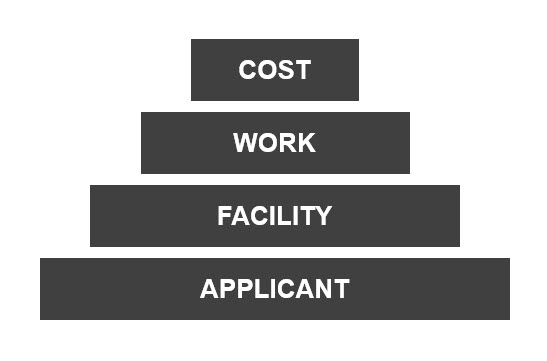
The four basic components of the Public Assistance Eligibility Pyramid are:

  • Applicant
  • Facility
  • Work
  • Cost
Pyramid showing the four basic components of eligibility. From bottom to top: Applicant, Facility, Work, Cost.
Components of Eligibility (2 of 2)

The Federal Emergency Management Agency refers to these components as the building blocks of the Eligibility Pyramid. Generally, FEMA must determine whether each building block is eligible, starting at the foundation (Applicant) and working up to the top of the pyramid (cost).

The Applicant is responsible for demonstrating that each component of the pyramid is eligible by providing supporting documentation.

  • FEMA accepts a variety of documentation to substantiate eligibility
  • In some cases, FEMA requires specific documentation to support eligibility

There are two exceptions to the standard Eligibility Pyramid:

  • Private nonprofits must own or operate an eligible facility in order for the Applicant to be eligible
  • Evaluating facility eligibility is not a necessary step for most Emergency Work  State, Territorial, Tribal, and Local Government Applicants
Activity: Locating and Saving a Local Copy of the Public Assistance Program and Policy Guide (1 of 4)

The Public Assistance Program and Policy Guide can easily be found by searching www.fema.gov.

First, type “PAPPG” in the search box and press ENTER.


fema.gov webpage with red box around "PAPPG" in the search field
Activity: Locating and Saving a Local Copy of the Public Assistance Program and Policy Guide (2 of 4)

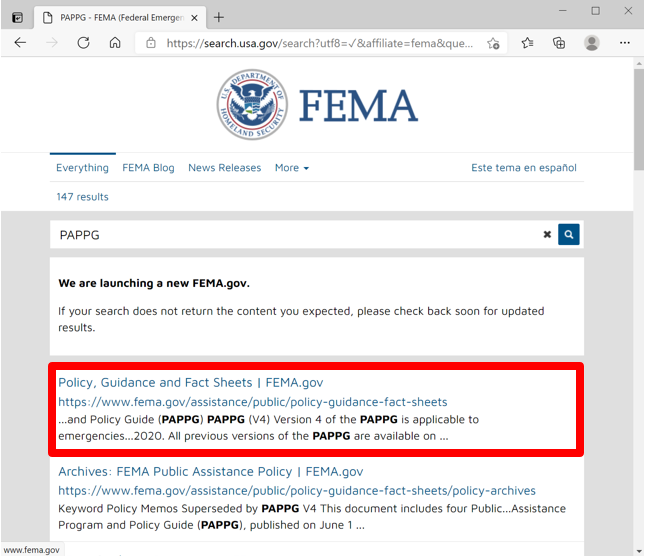
From the “fema.gov search results” page, locate and select the “Policy, Guidance and Fact Sheets”

This connects to the “Policy, Guidance and Fact Sheets” page, where the most recent version of the Public Assistance Program and Policy Guide can be downloaded.

fema.gov search results page with red box around "Policy, Guidance and Fact Sheets"
Activity: Locating and saving a local copy of the Public Assistance Program and Policy Guide (3 of 4)

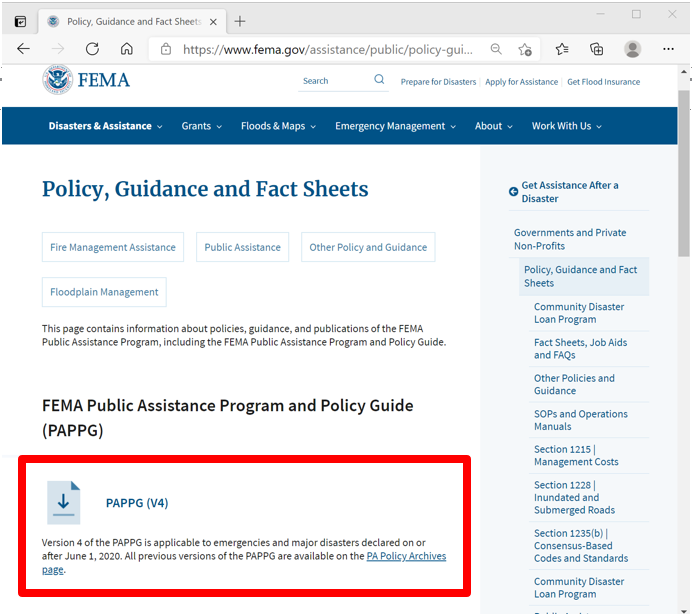
On the “Policy, Guidance and Fact Sheets” page, locate and select the hyperlinked “PAPPG (V4)”. This will then open a separate tab with the full Public Assistance Program and Policy Guide. Choose the most recent version of the PAPPG that corresponds with the declaration timeframe of the disaster you are working with in your particular situation.

If you need an older version, click on the link “PA Policy Archives page” to get any of the previous versions.


"Policy, Guidance and Fact Sheets" page with red box around "PAPPG (V4)"
Activity: Locating and saving a local copy of the Public Assistance Program and Policy Guide (4 of 4)

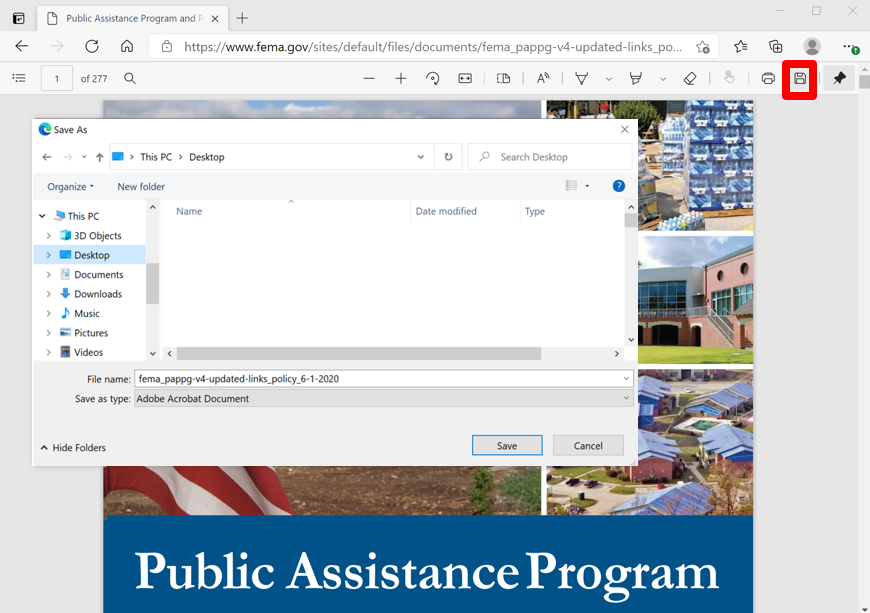
Once on the “FEMA Public Assistance Program and Policy Guide” page, In order to save a copy of the Public Assistance Program and Policy Guide, navigate to the top right corner of the document and select the diskette icon, which should be second from the right.

A pop-up window will open and provide the option to save the Guide to your desktop. Select the preferred destination (i.e. the desktop), select "save." A copy of the Public Assistance Program and Policy Guide has been saved for personal reference.

PAPPG with red box around diskette icon showing pop-up window to save the file
Activity: Searching in the Public Assistance Program and Policy Guide

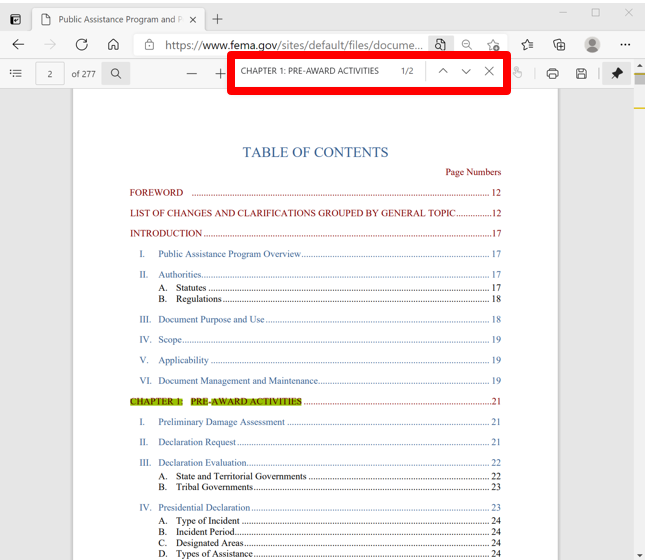
Though the Public Assistance Program and Policy Guide is a large document, it is fairly easy to navigate. This can be done by either clicking on a specific section in the “Table of Contents” or by using the “Ctrl-F” function on the keyboard to search for specific keywords or topics.

For example, to locate “CHAPTER 1: PRE-AWARD ACTIVITIES,” either select the title in the “Table of Contents” or enter it in the search box after selecting “Ctrl-F.”

PAPPG with red box around "CHAPTER 1: PRE-AWARD ACTIVITIES" in the search field
Lesson 1 Summary

This lesson covered the Declaration Process and provided an overview of Public Assistance Program eligibility.

The next lesson provides an overview of the Applicants eligible to receive Public Assistance Program grants and how to locate Applicant eligibility in the Public Assistance Program and Policy Guide.