National Infrastructure Protection Plan Sector Partnership Model
  • Sector Partnership Model
  • Sector Partnership Coordination
  • Sector Coordinating Councils (SCCs)
  • Government Coordinating Councils (GCCs)
  • Critical Infrastructure Cross-Sector Council
  • Federal Senior Leadership Council (FSLC)
  • State, Local, Tribal, and Territorial Government Coordinating Council (SLTTGCC)
  • Regional Consortium Coordinating Council (RC3)
  • Critical Infrastructure Partnership Advisory Council (CIPAC)
  • International Coordination

Sector Partnership Model: To be effective, the NIPP must be implemented using organizational structures and partnerships committed to sharing and protecting the information needed to achieve the NIPP goal and supporting objectives. DHS, in close collaboration with the Sector-Specific Agencies, is responsible for overall coordination of the NIPP partnership framework and information sharing network. The coordination mechanisms establish linkages among critical infrastructure protection efforts at the Federal, State, regional, local, tribal, territorial, and international levels as well as between public- and private-sector partners.

In addition to direct coordination between partners, the structures described below provide a national framework that fosters relationships and facilitates coordination within and across critical infrastructure sectors.
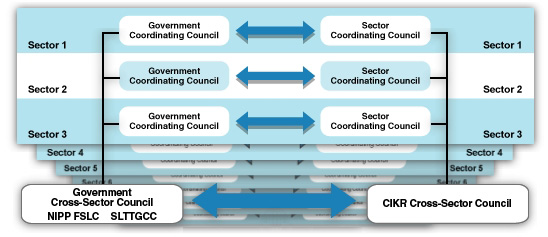

Government and CIKR Cross-Sector Council
National Infrastructure Protection Plan Sector Partnership Model
Back to top
Sector Partnership Coordination: The Critical Infrastructure Cross-Sector Council, the Government Cross-Sector Council (made up of two subcouncils: the NIPP Federal Senior Leadership Council and the State, Local, Tribal, and Territorial Government Coordinating Council), the Regional Consortium Coordinating Council, and individual Sector Coordinating Councils and Government Coordinating Councils create a structure through which government and the private sector can collaborate and develop consensus approaches to critical infrastructure protection.
National Infrastructure Protection Plan Sector Partnership Model
Back to top
Sector Coordinating Councils (SCCs): The sector partnership model encourages critical infrastructure owners and operators to create or identify a Sector Coordinating Council as the principal private sector entity for coordinating with the government on a wide range of critical infrastructure protection activities and issues. Specific membership will vary by sector, reflecting each sector’s unique composition; however, membership should be representative of a broad base of owners, operators, associations, and other entities within a sector.
National Infrastructure Protection Plan Sector Partnership Model
Back to top
Government Coordinating Councils (GCCs): A Government Coordinating Council is formed as the government counterpart to the State Coordinating Council to enable interagency and cross-jurisdictional coordination. A Government Coordinating Council is comprised of representatives across various levels of government (Federal, State, local, tribal, and territorial) as appropriate to the security landscape of each sector.
National Infrastructure Protection Plan Sector Partnership Model
Back to top
Critical Infrastructure Cross-Sector Council: The Critical Infrastructure Cross-Sector Council serves as a forum where cross-sector issues and interdependencies are addressed. The Council is comprised of the leadership of the Sector Coordinating Councils. This representation for the Cross-Sector Council is provided through the Partnership for Critical Infrastructure Security, which supports the critical infrastructure mission by identifying and raising awareness of relevant legislative issues.
National Infrastructure Protection Plan Sector Partnership Model
Back to top
Federal Senior Leadership Council (FSLC): The objective of the NIPP Federal Senior Leadership Council is to drive enhanced communications and coordination among Federal departments and agencies that have a role in implementing the NIPP and Homeland Security Presidential Directive 7, “Critical Infrastructure Identification, Prioritization, and Protection.” The members of the Federal Senior Leadership Council include the Sector-Specific Agencies for each of the critical infrastructure sectors as well as several additional agencies named in the Directive.
National Infrastructure Protection Plan Sector Partnership Model
Back to top
State, Local, Tribal, and Territorial Government Coordination Council (SLTTGCC): The State, Local, Tribal, and Territorial Government Coordination Council ensures that State, local, and tribal homeland security partners are fully integrated as active participants in national critical infrastructure protection efforts, and provides an organizational structure to coordinate across jurisdictions on State and local government-level critical infrastructure protection guidance, strategies, and programs. This council provides the State, local, tribal, or territorial perspective or feedback on a wide variety of critical infrastructure issues and provides liaison representatives to each Government Coordinating Council.
National Infrastructure Protection Plan Sector Partnership Model
Back to top
Regional Consortium Coordinating Council (RC3): The Regional Consortium Coordinating Council brings together representatives of regional partnerships, groupings, and governance bodies to enable critical infrastructure protection coordination among partners within and across geographical areas and sectors.
National Infrastructure Protection Plan Sector Partnership Model
Back to top
Critical Infrastructure Partnership Advisory Council (CIPAC): The Critical Infrastructure Partnership Advisory Council directly supports the sector partnership model by providing a legal framework for members of the State Coordinating Councils and Government Coordinating Councils to engage in joint critical infrastructure protection-related activities. The Critical Infrastructure and Partnership Advisory Council serves as a forum where government and private sector partners are able to engage in a broad spectrum of activities including: planning, coordination, implementation, and operational issues; implementation of programs; operational activities related to critical infrastructure protection, response, and recovery; and development and support of national plans, including the NIPP and Sector-Specific Plans.
National Infrastructure Protection Plan Sector Partnership Model
Back to top
International Coordination: The United States-Canada-Mexico Security and Prosperity Partnership, the North Atlantic Treaty Organization’s Senior Civil Emergency Planning Committee, certain government councils such as the Committee on Foreign Investment in the United States, and consensus-based nongovernmental or public-private organizations enable a range of critical infrastructure protection coordination activities associated with established international agreements.
National Infrastructure Protection Plan Sector Partnership Model
Back to top