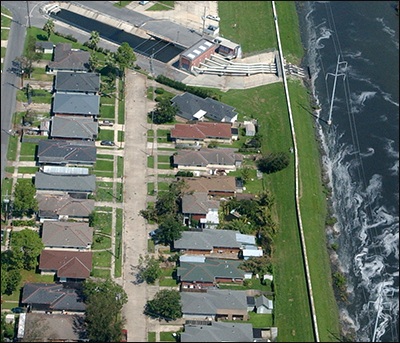
Levees are man-made structures or engineered fill that extend above the flood elevation to prevent areas behind the levee from being inundated by floodwaters. For a levee, the information in this section includes the type of levee (e.g., flood control, agricultural, etc.), the name of the agency or organization that constructed the levee, the date of construction, the name of the agency or organization that maintains the levee, the level of protection provided by the levee (e.g., the magnitude of the flood that will overtop the levee) and the historical performance of the levee.
FEMA does not own, maintain, or set standards for how levees are built. However, in order for a levee to be accredited as providing flood protection, it must meet certain standards. It must:
- have a minimum of three feet of freeboard against the 1% annual chance flood event;
- be equipped with closure devices at every opening;
- be constructed with embankments and foundations that are certified not to fail due to erosion, seepage, or instability; and
- be certified against future loss of freeboard due to settling.
For additional requirements, refer to 44 CFR 65.10 available at https://ecfr.io/Title-44/se44.1.65_110.