To prepare the flood maps that illustrate the extent of flood hazards in a flood prone community, FEMA generally conducts engineering studies to determine flood frequencies, flood elevations, floodway determinations, and flood inundation boundaries. FEMA maintains Guidelines and Standards for flood risk analysis and mapping for all steps in the flood mapping process. Using the information gathered in these studies, FEMA engineers and cartographers delineate Special Flood Hazard Areas (SFHAs) on flood maps. SFHAs are subject to inundation by a flood that has a 1-percent or greater chance of being equaled or exceeded during any given year. This type of flood is commonly referred to as the "100-year flood" however, it is more accurate to call it the 1-percent annual chance flood, or base flood.
A 100-year flood is not a flood that occurs every 100 years!
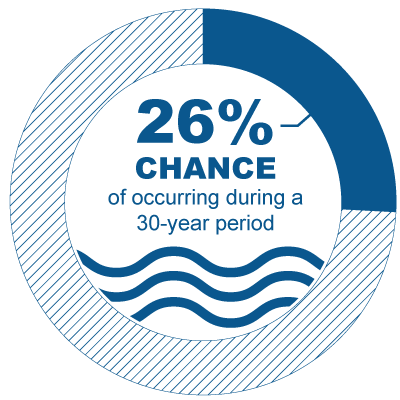
In fact, the 1-percent annual chance flood has a 26% chance of occurring during a 30-year period, the length of many mortgages.
"100-year flood” is essentially synonymous with the “1-percent annual chance flood”:
- The 100-year flood is a regulatory standard used by Federal agencies and most states to administer floodplain management programs.
- The 1-percent annual chance flood is used by the National Flood Insurance Program (NFIP) as the basis for insurance requirements nationwide.