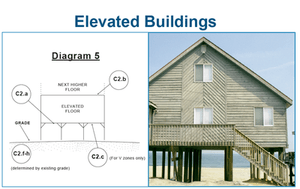
As you might recall from Lesson 2, the SFIP defines an elevated building as a building that has no basement and has its lowest elevated floor raised above ground level by any of the following:
- Foundation walls
- Posts
- Piers
- Pilings
- Columns
When adjusting an elevated building claim it is important to know whether the building is in a Special Flood Hazard Area (SFHA), as specified in Section III. Property Insured, A.8, and whether the building is Pre-FIRM or Post-FIRM. Remember:
A Pre-FIRM building is a building which was built prior to the initial FIRM date and, regardless of the zone it is in, does not have Post-FIRM limitations below the lowest elevated floor
A Post-FIRM building is a building which was built or substantially improved after December 31, 1974 or on or after the effective date of the initial FIRM, whichever is later. Limitations of the SFIP will then apply
Note: To review a list of the building and personal property insured, see Section III, Property Insured.